Durations and group sizes
Each figure above is the course length followed by the most delegates we take on it. In-house tests are timed per person. NPORS courses end with a practical assessment and a short written theory test.
NPORS accredited
Find the machine, then pick the route. A full NPORS course for someone new to it, the shorter experienced worker course for someone who is not, or a quick in-house test for operators you already trust.
NVQ to follow: Excavating (360)
Enquire about 360 & 180 excavatorsNVQ to follow: Transporting Loads (Dumper)
Enquire about Site dumpersNVQ to follow: Compacting (Ride on Roller)
Enquire about Ride on rollerNVQ to follow: Forklift Truck (Telehandler)
Enquire about Telescopic handlersAsk us about the next step after the card.
Enquire about Industrial forkliftNVQ to follow: Work Platforms (MEWPs)
Enquire about MEWPsNVQ to follow: Cranes and Specialist Lifting Plant, or Loading and Securing (Slinger / Signaller)
Enquire about Lifting operationsNVQ to follow: Movement Guide (Plant and Vehicle Marshal)
Enquire about Plant & vehicle marshallingNOCN · Cskills Awards
An NVQ is earned on the job, not in a classroom. Our assessors come to the workplace and judge the work your people are already doing against the national standard.
Level 2
For operators holding a red card. Each needs a valid, in-date NPORS or CPCS ticket for the machine they are being assessed on.
Level 2
For experienced groundworkers working towards the blue Skilled Worker card. Pick the categories that match the work they already do.
Level 3
An NVQ Diploma for people supervising work on site, assessed in the role.
Enquire about the Level 3 NVQ in Occupational Work Supervision (Construction)Level 4
An NVQ Diploma for site supervisors.
Enquire about the Level 4 NVQ in Construction Site SupervisionLevel 6
An NVQ Diploma at management level.
Enquire about the Level 6 NVQ in Construction Contracting Operations ManagementEUSR and in-house
Each course combines theory with practical work. EUSR courses lead to an EUSR card; in-house courses lead to a KOPLANT competency certificate and card. Both last three years.
Find cables and pipes before the bucket does. Theory and hands-on practice with the CAT & Genny, to HSG47.
Cut-off saws and grinders: pre-use checks, mounting the wheel and cutting different materials safely.
Recognising the risk, using the right equipment and knowing what to do in an emergency.
The slow hazards: dust, vibration, noise and lifting, plus checking that masks actually fit.
New Roads and Street Works Act 1991
Street works training is required by law for anyone working on or near public roads and footpaths. We arrange it through our sister company, KOAST (Southern), who specialise in NRSWA qualifications.
Operative units cover the physical work: locating and avoiding underground apparatus, signing, lighting and guarding, excavation, and reinstatement in each type of material. Supervisor units cover monitoring that same work. Both are reassessed every five years, and KOAST handle initial certification, renewal and reassessment.
Questions
Rather talk it through? Call 0333 0348 368 or send a WhatsApp message.
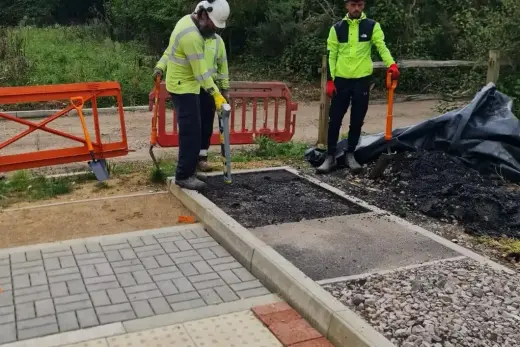
Yes. On-site delivery is what KOPLANT specialise in. A trainer comes to your place of work and runs the theory, the practical and the assessment there.
Where that is not suitable, training can be carried out at our Dorset training centre in Blandford, depending on the course. KOPLANT also has a centre in Eastleigh, Hampshire.
It depends on the course. NPORS plant courses are kept small, with a maximum of two to six delegates. In-house safety courses take larger groups: up to eight for cable avoidance, ten for abrasive wheels and confined space, and twelve for occupational health.
Not necessarily. NPORS has an experienced worker route, which for most machines is seven hours. To qualify, an operator needs 18 months of provable work experience, or six months of consistent daily experience, in that category.
For in-house certification there are also test-only options on several machines, typically one or two hours per person.
An in-date CITB Health, Safety and Environment touchscreen test, and a good understanding of spoken and written English. Novices need no previous experience. If someone needs extra support, tell us and we will make reasonable adjustments.
A traditional NPORS card lasts five years. A red NPORS/CSCS Trained Operator card lasts two years, and becomes a blue Competent Operator card, valid for five years, once the NVQ is complete.
EUSR cards and KOPLANT in-house certificates last three years. Street works operatives and supervisors are reassessed every five years.
Yes. If you are registered with the CITB, we can help you claim the grant once NPORS training is complete. We submit the application for you and the money goes straight to your business. With NVQs, we can assist with the short duration grant claim.
Yes. Courses are open to individuals who want to move their career on as well as to organisations that need to improve the competence of a workforce.
Yes. Tell us the roles, the machines and the cards people already hold, and we will talk through the options and recommend the most appropriate course.
Request a quote
Tell us which service, how many people and where. We will reply with the right courses, dates and where each one can run.